
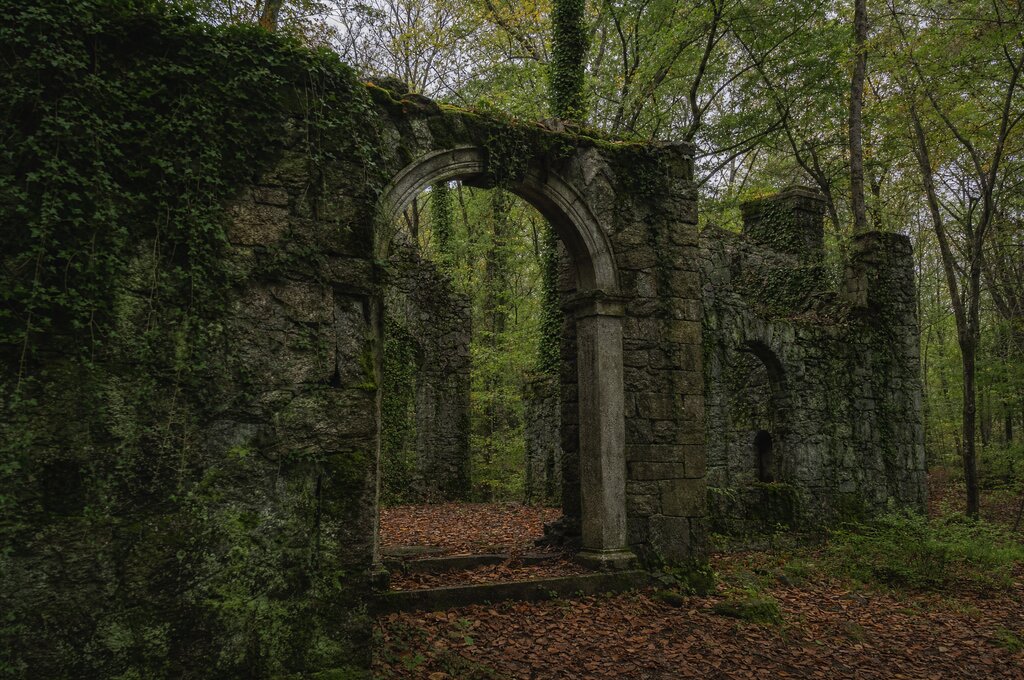
The first time you see the ruins, you have to stop walking. Through the trees, a stone wall rises — too straight, too deliberate to be natural. Then another wall, then an archway, then a staircase that leads nowhere. You're standing in what was once the basement of one of the largest private homes in America. Now it's forest. The trees have been growing through the floorboards for a century.
This is Rockwood Hall, and it's one of the most remarkable walks in Westchester County — a place where Gilded Age excess and Hudson Valley forest have merged into something that feels less like a ruin and more like a slow-motion collision between human ambition and nature's patience.
What Was Rockwood Hall?
Rockwood Hall was the estate of William Rockefeller, brother of John D. Rockefeller, and was one of several grand estates that dotted the Pocantico Hills area in the late 1800s and early 1900s. The mansion was enormous — over 200 rooms at its peak, with a staff of hundreds, formal gardens, and a private rail spur to bring guests from New York City.
The estate didn't last. After William Rockefeller's death, the property changed hands several times. The mansion was eventually demolished in the 1940s, and the land was absorbed into what is now the Rockefeller State Park Preserve. But the demolition wasn't complete. The foundation walls, the basement level, and some of the garden structures were left in place — and the forest reclaimed them.
What remains today is a network of stone walls, archways, and staircases spread across a hillside overlooking the Hudson River. The ruins are not marked or restored. They're simply there, in the woods, waiting to be found.
The Walk to the Ruins
The Rockwood Hall trail is part of the Rockefeller State Park Preserve trail system. The preserve has over 55 miles of carriage roads — wide, stone-dust paths built by the Rockefeller family for horse-drawn carriages — and the Rockwood Hall section is one of its most scenic loops.
Getting There
Park at the Rockefeller State Park Preserve visitor center on Route 117 in Pocantico Hills. From the parking lot, take the trail toward the river — the Rockwood Hall area is well-marked on the preserve map. The walk from the parking lot to the ruins is about 20 minutes, mostly downhill on carriage roads.
Alternatively, you can park at the smaller Phelps Memorial Hospital lot and access the trail from the south, but the visitor center route is more straightforward for first-time visitors.
The Trail Experience
The carriage roads are wide and easy to walk — suitable for all ages and fitness levels. As you descend toward the river, the forest thickens. The trees here are old-growth — oaks and tulip trees that were already mature when the mansion was standing. In spring, wildflowers carpet the understory. In fall, the foliage is spectacular — see our fall foliage guide for why this part of the county is peak autumn territory.
The ruins appear gradually. First, you'll notice a stone wall parallel to the trail — too refined for a farm wall. Then the trail passes through what was once a gateway, and suddenly you're inside the footprint of the mansion. The walls are chest-high in places, lower in others. Stone staircases descend into what were once cellars. Arched doorways frame views of forest.
What to Look For
The Foundation Walls
The most impressive feature is the sheer scale of the foundation. Walk the perimeter and try to imagine the building that stood here — it covered a footprint larger than most modern hotels. The craftsmanship in the stonework is still visible: precisely cut blocks, arched doorways, and the kind of masonry that doesn't exist anymore.
The River View
Behind the ruins, the hillside drops steeply toward the Hudson. There's an overlook (with a stone wall that was once part of the estate's terrace) that offers one of the best river views in the park. On a clear day, you can see the Palisades and, to the north, the Catskills on the horizon.
The Garden Remnants
Scattered through the woods near the main ruins are remnants of the estate's formal gardens — stone paths, low walls, and the occasional piece of statuary. These are easy to miss if you don't know to look for them. Wander off the main trail (but stay on marked paths) and you'll find them.
The Tunnel
One of the most photographed features is a stone tunnel that once carried a service road under the estate's driveway. It's still intact — a dark, arched passage that looks like something from a fantasy novel. Walk through it; it's safe and short.
The trees don't know they're growing through a mansion. They just grow. And in doing so, they've created something the Rockefellers never intended — a ruin that feels like it was always meant to be a ruin.
Practical Information
Trail Difficulty
The carriage roads are flat and wide — suitable for walking, running, and even strollers. The side trails near the ruins are narrower and can be root-covered. Wear walking shoes; hiking boots are unnecessary.
Time Needed
Allow 90 minutes to two hours for the Rockwood Hall loop, including time to explore the ruins. If you want to extend the walk, the preserve connects to other trail systems — you could spend an entire day here.
Parking and Access
Parking at the preserve visitor center is free. The preserve is open daily from dawn to dusk. There are restrooms at the visitor center.
Best Time to Visit
The ruins are atmospheric in any season, but they're most photogenic in late fall and winter, when the leaf cover is down and more of the stonework is visible. Spring brings wildflowers. Summer is lush but the ruins are more hidden. Avoid the preserve during peak fall foliage weekends — the parking lot fills by 9 AM.
What to Bring
A camera. The ruins are one of the most photogenic spots in Westchester. Also bring water, a trail map (available at the visitor center), and insect repellent in summer — this is tick country. See our disclaimer for outdoor activity risks.
Combining Your Visit
Rockefeller State Park Preserve is in Pocantico Hills, which puts it within easy reach of several other attractions:
- The Old Croton Aqueduct Trail passes through nearby Ossining — combine a morning at the ruins with an afternoon on the trail.
- Stone Barns Center for Agriculture is adjacent to the preserve — a working farm and educational center with a cafe. Check their hours.
- The Neuberger Museum on the nearby Purchase College campus offers free Sunday admission — a nice indoor complement to an outdoor morning.
Rockwood Hall is the kind of place that changes how you see Westchester. You can walk past it without knowing it's there — many people do. But once you've stood inside those walls and felt the weight of the history and the patience of the forest, you start to wonder what else is hiding in these woods. That curiosity is what this guide is about. Keep exploring.