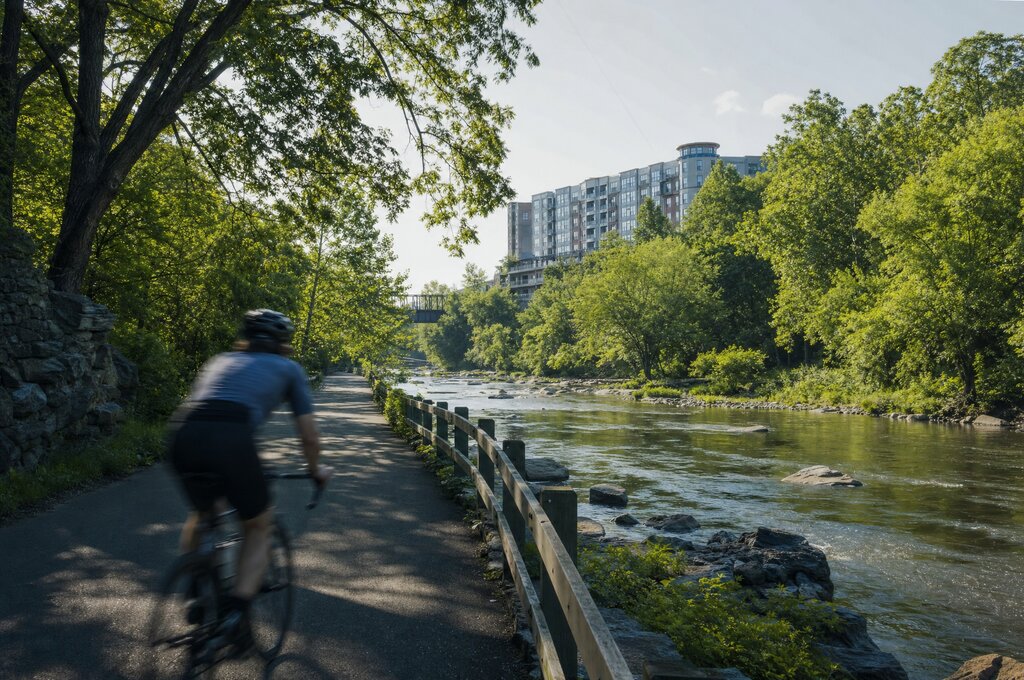
Let me start with the honest part: the Saw Mill River Greenway is not a beautiful trail. It's not the kind of ride you do for the scenery. It runs alongside a river, yes, but it also runs alongside the Saw Mill River Road, the Sprain Brook Parkway, and a series of parking lots, retention basins, and back fences that aren't exactly postcard material. If you're looking for a Hudson River view ride, check our fall foliage guide and plan a road route instead.
But here's what the Saw Mill River Greenway is: the best paved, car-free, long-distance cycling path in Westchester County. It connects to a trail network that runs over 40 miles. It's flat, fast, and mostly uninterrupted. For commuters, fitness riders, and anyone who wants to put in miles without worrying about traffic, it's the county's most important cycling infrastructure. And it's getting better — recent extensions and improvements have addressed some of the trail's long-standing gaps.
I've ridden every mile of the greenway and its connected trails across multiple seasons. Here's the honest review — the good, the bad, and the practical.
The Trail Network
First, let's clarify what we're talking about. The "Saw Mill River Greenway" is part of a larger network of paved trails in Westchester that were built along former railroad rights-of-way. The main components are:
- South County Trailway: Runs from Van Cortlandt Park in the Bronx (at the Westchester border) north through Yonkers, Hastings, Dobbs Ferry, and Irvington to the Tibbetts Brook Park area. About 14 miles.
- North County Trailway: Continues north from Tibbetts Brook through Elmsford, Eastview, and Millwood to Baldwin Place. About 14 miles.
- Putnam Trailway: Extends further north from Baldwin Place through Putnam County. About 12 miles (and growing).
Ridden end to end, this network gives you over 40 miles of continuous paved trail — one of the longest paved trail systems in the New York metropolitan area. You can ride from the Bronx to Putnam County without sharing the road with a car. That's remarkable, and it's something Westchester doesn't get enough credit for.
What's Good
The Surface
The trail is paved — mostly asphalt — and generally well-maintained. It's smooth enough for road bikes with thin tires, which is not true of all rail-trails. The surface is the single biggest factor in why this trail is so popular with cyclists — you can maintain speed without dodging cracks, roots, or gravel.
The Grade
Because the trail follows a former railroad right-of-way, the grade is gentle — never more than 2-3% in most sections. This makes it accessible for cyclists of all fitness levels. You can ride 30 miles without ever encountering a hill that forces you out of the saddle. For fitness riders training for longer events, this is the ideal training ground.
The Distance
40+ miles of continuous trail is rare in the Northeast. Most paved trails are 5-10 miles. The Saw Mill River Greenway network lets you plan rides of any distance — a quick 10-mile out-and-back, a 30-mile loop, or a century ride if you're training for one. The trail's length is its greatest asset.
The Connectivity
The trail connects to parks, village centers, and Metro-North stations along its length. You can start a ride in Yonkers, stop for coffee in Hastings, continue to Tarrytown, and take the train home. This flexibility makes the trail useful for everything from a quick workout to a full-day adventure.
What's Not Good
The Noise
For much of its length, the trail runs alongside the Saw Mill River Parkway. The road noise is constant and, in some sections, loud. You're never fully in nature — you're in a green corridor that happens to be next to a highway. If you ride to escape the sound of cars, this trail will disappoint you.
The Crossings
The trail crosses roads at grade — meaning you have to stop and wait for traffic at major intersections. Some of these crossings are well-designed with signals and crosswalks; others require you to cross busy roads with no protection. The crossings at Route 119 in Elmsford and at several points in Yonkers are particularly frustrating. They break your rhythm and add minutes to your ride.
The Crowds
On warm weekends, the southern sections (Yonkers to Hastings) are packed with walkers, joggers, families with strollers, and dog walkers. Cyclists are expected to slow down and yield, which means your average speed drops significantly. If you want to ride fast, go early (before 8 AM) or on weekdays.
The Flooding
The trail follows the Saw Mill River, and in heavy rain, sections of the trail flood. This is particularly true in the Yonkers and Hastings sections. After a storm, check trail conditions before you head out — the trail may be closed or have standing water.
The Saw Mill River Greenway is not the trail you ride for beauty. It's the trail you ride for miles. And 40 miles of paved, car-free trail is nothing to complain about.
Section-by-Section Review
South County (Yonkers to Irvington) — 4 out of 5
The most popular section, and the most crowded. The trail here is wide, well-paved, and passes through several river villages. The scenery is a mix of river, parking lots, and back fences. The village stops (Hastings, Dobbs Ferry) are highlights — you can pull off the trail for coffee or lunch.
Middle Section (Irvington to Eastview) — 3 out of 5
This section is quieter but less scenic. The trail passes through more industrial and commercial areas, with fewer village stops. The crossing at Route 119 in Elmsford is the worst on the trail — busy, confusing, and dangerous. Once you're past it, the riding improves.
North County (Eastview to Baldwin Place) — 4 out of 5
The trail opens up here, with fewer road crossings and more green space. The section through the Rockefeller State Park area is the greenest on the route. If you're looking for the best riding experience with the least road noise, start here. (You can also detour to the Rockwood Hall ruins — though that's an unpaved trail, so leave the road bike.)
Putnam Extension (Baldwin Place and beyond) — 5 out of 5
The further north you go, the better the trail gets. The Putnam Trailway is newer, quieter, and more scenic than the southern sections. If you have the fitness to ride this far, do it — the extra miles are worth it. The trail here feels more like a rail-trail and less like a roadside path.
Practical Guide for Cyclists
What Bike to Bring
Road bike: Perfect. The surface is smooth enough for 25mm tires. Watch for debris at road crossings.
Gravel bike: Also great, though unnecessary — you won't need the wider tires. But if you want to detour onto the Old Croton Aqueduct Trail (unpaved), a gravel bike gives you options.
Hybrid/commuter: Ideal. This trail was built for commuters, and a hybrid bike is the perfect tool.
Mountain bike: Overkill. The trail is fully paved. But if it's what you have, ride it.
Where to Park
- Southern start: Tibbetts Brook Park lot (see our park guide for details)
- Central start: Eastview Station lot or the County Center lot in White Plains
- Northern start: Baldwin Place lot or the Millwood Station lot
What to Bring
- Two water bottles (there are few fountains on the trail)
- Tire pump, spare tube, and patch kit
- Phone with offline maps (cell service is generally good but not perfect)
- Helmet (required by law for cyclists under 14, recommended for everyone)
- Light if riding near dawn or dusk (the trail is not lit)
Trail Etiquette
The trail is multi-use — cyclists share it with walkers, runners, and families. The rules are simple: announce when passing ("on your left"), pass at a safe speed, yield to pedestrians, and slow down in crowded sections. The trail is not a race course — if you want to go fast, go early when it's empty.
The Verdict
The Saw Mill River Greenway is not a perfect trail. It's noisy in places, it has frustrating road crossings, and it's not the most scenic ride in the county. But it is the most useful cycling infrastructure in Westchester — the trail that makes long-distance, car-free riding possible for thousands of cyclists. Without it, Westchester cycling would be a fraction of what it is.
If you're a cyclist in Westchester, this trail is your backbone. Learn its quirks, plan around its weaknesses, and appreciate it for what it does well. And when you want something prettier, explore the county's other trail options — the Old Croton Aqueduct for walking, or the scenic road routes for a different kind of riding experience.
The Saw Mill River Greenway won't be the most beautiful ride you ever do. But it might be the one you use the most. And that's worth something.